Introduction
“If you want it
done right, you may as well do it yourself.”
This aphorism may seem appropriate if you are a picky housekeeper, but
more and more people are beginning to realize it can also apply to large
corporations, community development projects, and even national
governments. Such entities exist
increasingly in an interdependent world, and are relying on Action Research as
a means of coming to grips with their constantly changing and turbulent
environments.
This paper will
answer the question “What is Action Research?”, giving an overview of its
processes and principles, stating when it is appropriate to use, and situating
it within a praxis research paradigm.
The evolution of the approach will be described, including the various
kinds of action research being used today.
The role of the action researcher will be briefly mentioned, and some
ethical considerations discussed. The
tools of the action researcher, particularly that of the use of search
conferences, will be explained. Finally
three case studies will be briefly described, two of which pertain to action
research projects involving information technology, a promising area needing
further research.
What is Action Research?
Definition
Action research
is known by many other names, including participatory research, collaborative
inquiry, emancipatory research, action learning, and contextural action
research, but all are variations on a theme. Put simply, action research is
“learning by doing” - a group of people identify a problem, do something to
resolve it, see how successful their efforts were, and if not satisfied, try
again. While this is the essence of the
approach, there are other key attributes of action research that differentiate
it from common problem-solving activities that we all engage in every day. A more succinct definition is,
"Action
research...aims to contribute both to the practical concerns of people in an
immediate problematic situation and to further the goals of social science
simultaneously. Thus, there is a dual
commitment in action research to study a system and concurrently to collaborate
with members of the system in changing it in what is together regarded as a
desirable direction. Accomplishing this
twin goal requires the active collaboration of researcher and client, and thus
it stresses the importance of co-learning as a primary aspect of the research
process."[i]
What separates
this type of research from general professional practices, consulting, or daily
problem-solving is the emphasis on scientific study, which is to say the
researcher studies the problem systematically and ensures the intervention is
informed by theoretical considerations.
Much of the researcher’s time is spent on refining the methodological
tools to suit the exigencies of the situation, and on collecting, analyzing,
and presenting data on an ongoing, cyclical basis.
Several
attributes separate action research from other types of research. Primary is its focus on turning the people
involved into researchers, too - people learn best, and more willingly apply
what they have learned, when they do it themselves. It also has a social dimension - the research takes place in
real-world situations, and aims to solve real problems. Finally, the initiating researcher, unlike
in other disciplines, makes no attempt to remain objective, but openly
acknowledges their bias to the other participants.
The Action Research Process
Stephen Kemmis has developed a simple model of the cyclical nature of the typical action research process (Figure 1). Each cycle has four steps: plan, act, observe, reflect.

Figure 1 Simple Action Research Model
(from MacIsaac, 1995)[ii]
Gerald Susman
(1983) gives a somewhat more elaborate listing. He distinguishes five phases to be conducted within each research
cycle (Figure 2). Initially, a problem
is identified and data is collected for a more detailed diagnosis. This is followed by a collective postulation
of several possible solutions, from which a single plan of action emerges and
is implemented. Data on the results of
the intervention are collected and analyzed, and the findings are interpreted
in light of how successful the action has been. At this point, the problem is re-assessed and the process begins
another cycle. This process continues
until the problem is resolved.
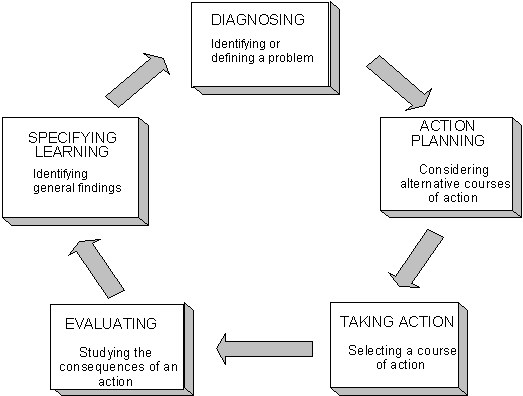
Figure 2 Detailed Action Research Model
(adapted from Susman 1983)[iii]
Principles of Action Research
What gives action
research its unique flavour is the set of principles that guide the
research. Winter (1989) provides a
comprehensive overview of six key principles.[iv]
1) Reflexive critique
An
account of a situation, such as notes, transcripts or official documents, will
make implicit claims to be authoritative, i.e., it implies that it is factual
and true. Truth in a social setting,
however, is relative to the teller. The
principle of reflective critique ensures people reflect on issues and processes
and make explicit the interpretations, biases, assumptions and concerns upon
which judgments are made. In this way,
practical accounts can give rise to theoretical considerations.
2) Dialectical critique
Reality,
particularly social reality, is consensually validated, which is to say it is
shared through language. Phenomena are
conceptualized in dialogue, therefore a dialectical critique is required to
understand the set of relationships both between the phenomenon and its
context, and between the elements constituting the phenomenon. The key elements to focus attention on are
those constituent elements that are unstable, or in opposition to one
another. These are the ones that are
most likely to create changes.
3) Collaborative Resource
Participants
in an action research project are co-researchers. The principle of collaborative resource presupposes that each
person’s ideas are equally significant as potential resources for creating
interpretive categories of analysis, negotiated among the participants. It strives to avoid the skewing of
credibility stemming from the prior status of an idea-holder. It especially makes possible the insights
gleaned from noting the contradictions both between many viewpoints and within
a single viewpoint
4) Risk
The
change process potentially threatens all previously established ways of doing
things, thus creating psychic fears among the practitioners. One of the more prominent fears comes from
the risk to ego stemming from open discussion of one’s interpretations, ideas,
and judgments. Initiators of action
research will use this principle to allay others’ fears and invite participation
by pointing out that they, too, will be subject to the same process, and that
whatever the outcome, learning will take place.
5) Plural Structure
The
nature of the research embodies a multiplicity of views, commentaries and
critiques, leading to multiple possible actions and interpretations. This plural structure of inquiry requires a
plural text for reporting. This means
that there will be many accounts made explicit, with commentaries on their
contradictions, and a range of options for action presented. A report, therefore, acts as a support for
ongoing discussion among collaborators, rather than a final conclusion of fact.
6) Theory, Practice, Transformation
For
action researchers, theory informs practice, practice refines theory, in a
continuous transformation. In any setting,
people’s actions are based on implicitly held assumptions, theories and
hypotheses, and with every observed result, theoretical knowledge is
enhanced. The two are intertwined
aspects of a single change process. It
is up to the researchers to make explicit the theoretical justifications for
the actions, and to question the bases of those justifications. The ensuing practical applications that
follow are subjected to further analysis, in a transformative cycle that
continuously alternates emphasis between theory and practice.
When is Action Research used?
Action research
is used in real situations, rather than in contrived, experimental studies,
since its primary focus is on solving real problems. It can, however, be used by social scientists for preliminary or
pilot research, especially when the situation is too ambiguous to frame a
precise research question. Mostly,
though, in accordance with its principles, it is chosen when circumstances
require flexibility, the involvement of the people in the research, or change
must take place quickly or holistically.
It is often the
case that those who apply this approach are practitioners who wish to improve
understanding of their practice, social change activists trying to mount an
action campaign, or, more likely, academics who have been invited into an
organization (or other domain) by decision-makers aware of a problem requiring
action research, but lacking the requisite methodological knowledge to deal
with it.
Situating Action Research in a Research Paradigm
Positivist Paradigm
The main research
paradigm for the past several centuries has been that of Logical
Positivism. This paradigm is based on a
number of principles, including: a belief in an objective reality, knowledge of
which is only gained from sense data that can be directly experienced and
verified between independent observers.
Phenomena are subject to natural laws that humans discover in a logical
manner through empirical testing, using inductive and deductive hypotheses
derived from a body of scientific theory. Its methods rely heavily on
quantitative measures, with relationships among variables commonly shown by
mathematical means. Positivism, used in
scientific and applied research, has been considered by many to be the
antithesis of the principles of action research (Susman and Evered 1978, Winter
1989).
Interpretive Paradigm
Over the last
half century, a new research paradigm has emerged in the social sciences to
break out of the constraints imposed by positivism. With its emphasis on the relationship between socially-engendered
concept formation and language, it can be referred to as the Interpretive
paradigm. Containing such qualitative
methodological approaches as phenomenology, ethnography, and hermeneutics,
it is characterized by a belief in a socially constructed, subjectively-based
reality, one that is influenced by culture and history. Nonetheless it still retains the ideals of
researcher objectivity, and researcher as passive collector and expert
interpreter of data.
Paradigm of Praxis
Though sharing a
number of perspectives with the interpretive paradigm, and making considerable
use of its related qualitative methodologies, there are some researchers who
feel that neither it nor the positivist paradigms are sufficient
epistemological structures under which to place action research (Lather 1986,
Morley 1991). Rather, a paradigm of
Praxis is seen as where the main affinities lie. Praxis, a term used by Aristotle, is the art of acting upon the
conditions one faces in order to change them.
It deals with the disciplines and activities predominant in the ethical
and political lives of people. Aristotle contrasted this with Theoria - those
sciences and activities that are concerned with knowing for its own sake. Both are equally needed he thought. That knowledge is derived from practice, and
practice informed by knowledge, in an ongoing process, is a cornerstone of
action research. Action researchers
also reject the notion of researcher neutrality, understanding that the most
active researcher is often one who has most at stake in resolving a problematic
situation.
Evolution of Action Research
Origins in late 1940s
Kurt Lewin is
generally considered the ‘father’ of action research. A German social and experimental psychologist, and one of the
founders of the Gestalt school, he was concerned with social problems, and
focused on participative group processes for addressing conflict, crises, and
change, generally within organizations.
Initially, he was associated with the Center for Group Dynamics at MIT
in Boston, but soon went on to establish his own National Training
Laboratories.
Lewin first
coined the term ‘action research’ in his 1946 paper “Action Research and
Minority Problems”,[v]
characterizing Action Research as “a comparative research on the conditions and
effects of various forms of social action and research leading to social
action”, using a process of “a spiral
of steps, each of which is composed of a circle of planning, action, and
fact-finding about the result of the action”.
Eric Trist,
another major contributor to the field from that immediate post-war era, was a
social psychiatrist whose group at the Tavistock Institute of Human Relations
in London engaged in applied social research, initially for the civil
repatriation of German prisoners of war. He and his colleagues tended to focus
more on large-scale, multi-organizational problems.
Both Lewin and
Trist applied their research to systemic change in and between
organizations. They emphasized direct
professional - client collaboration and affirmed the role of group relations as
basis for problem-solving. Both were
avid proponents of the principle that decisions are best implemented by those
who help make them.
Current Types of Action Research
By the mid-1970s,
the field had evolved, revealing 4 main ‘streams’ that had emerged:
traditional, contextural (action learning), radical, and educational action
research.
Traditional Action Research
Traditional
Action Research stemmed from Lewin’s work within organizations and encompasses
the concepts and practices of Field Theory, Group Dynamics, T-Groups, and the
Clinical Model. The growing importance
of labour-management relations led to the application of action research in the
areas of Organization Development, Quality of Working Life (QWL),
Socio-technical systems (e.g., Information Systems), and Organizational
Democracy. This traditional approach
tends toward the conservative, generally maintaining the status quo with
regards to organizational power structures.
Contextural Action Research (Action Learning)
Contextural Action Research, also sometimes referred to as
Action Learning, is an approach derived from Trist’s work on relations between
organizations. It is contextural, insofar as it entails
reconstituting the structural relations among actors in a social environment;
domain-based, in that it tries to involve all affected parties and
stakeholders; holographic, as each participant understands the working of the
whole; and it stresses that participants act as project designers and
co-researchers. The concept of
organizational ecology, and the use of search conferences come out of
contextural action research, which is more of a liberal philosophy, with social
transformation occurring by consensus and normative incrementalism.
Radical Action Research
The Radical
stream, which has its roots in Marxian ‘dialectical materialism’ and the praxis
orientations of Antonio Gramsci, has a strong focus on emancipation and the
overcoming of power imbalances. Participatory
Action Research, often found in liberationist movements and international
development circles, and Feminist Action Research both strive for social
transformation via an advocacy process to strengthen peripheral groups in
society.
Educational Action Research
A fourth stream,
that of Educational Action Research, has its foundations in the writings of
John Dewey, the great American educational philosopher of the 1920s and 30s,
who believed that professional educators should become involved in community
problem-solving. Its practitioners, not
surprisingly, operate mainly out of educational institutions, and focus on
development of curriculum, professional development, and applying learning in a
social context. It is often the case
that university-based action researchers work with primary and secondary school
teachers and students on community projects.
Action Research Tools
Action Research
is more of a holistic approach to problem-solving, rather than a single method
for collecting and analyzing data.
Thus, it allows for several different research tools to be used as the
project is conducted. These various
methods, which are generally common to the qualitative research paradigm,
include: keeping a research journal, document collection and analysis,
participant observation recordings, questionnaire surveys, structured and
unstructured interviews, and case studies.
The Search Conference
Of all of the tools utilized by action researchers, the one that has been developed exclusively to suit the needs of the action research approach is that of the search conference, initially developed by Eric Trist and Fred Emery at the Tavistock Institute in 1959, and first implemented for the merger of Bristol-Siddley Aircraft Engines in 1960.
The search conference format has seen widespread development
since that time, with variations on Trist and Emery’s theme becoming known
under other names due to their promotion by individual academics and
consultants. These include Dannemiller-Tyson’s Interactive Strategic Planning,
Marvin Weisbord's Future Search Conference, Dick Axelrod's Conference Model
Redesign, Harrison Owen’s Open Space, and ICA’s Strategic Planning (Rouda 1995).
Search conferences also have been conducted for many
different circumstances and participants, including: decision-makers from
several countries visioning the “Future of Participative Democracy in the
Americas”;[vi]
practitioners and policymakers in the field of health promotion in Ontario
taking charge in an era of cutbacks;[vii]
and Xerox employees sorting out enterprise re-organization.[viii]
Eric Trist sums
up the process quite nicely -
"Searching...is
carried out in groups which are composed of the relevant stakeholders. The group meets under social island
conditions for 2-3 days, sometimes as long as five. The opening sessions are concerned with elucidating the factors
operating in the wider contextual environment - those producing the
meta-problems and likely to affect the future.
The content is contributed entirely by the members. The staff are facilitators only. Items are listed in the first instance
without criticism in the plenary session and displayed on flip charts which
surround the room. The material is
discussed in greater depth in small groups and the composite picture checked
out in plenary. The group next examines
its own organizational setting or settings against this wider background and
then proceeds to construct a picture of a desirable future. It is surprising how much agreement there
often is. Only when all this has been
done is consideration given to action steps..."[ix]
Figure 3 provides
a schematic of a typical search conference.
|
Pre-conference process |
· set up Advisory Group of local representatives · agree on process design and participants · use focus groups for preparation · invitations, distribution of introductory materials |
|
|
|
Introductory plenary |
introductions, review objectives, outline process, introduce first stage |
|
|
|
Small
group session 1 |
SCANNING THE ISSUE · past and present context · assess current situation · outline probable futures |
|
|
|
Presentation plenary |
reports from small groups, discuss directions, introduce second stage |
|
|
|
Small group session 2 |
DESIRED FUTURES · long-range visions · alternative / preferred futures |
||
|
Presentation plenary |
reports, review progress, introduction to third stage |
|
|
|
Small
group session 3 |
OPTIONS FOR CHANGE · constraints and opportunities · possible futures |
|
|
|
Presentation plenary |
reports, define strategic tasks / actions, select key tasks, form task groups |
|
|
|
Task Group sessions |
TASK GROUP MEETINGS |
|
|
|
Final plenary |
Task Group reports, discuss future contacts, create new Advisory Group |
|
|
|
Post-conference
process |
· report distributed · follow-up contacts · Advisory Group facilitates meetings of Task Groups · feedback on proposed actions · further search conferences · widen network · continuing evaluation of outcomes |
|
|
Figure 3 - Search Conference
(adapted
from The ABL Group, 1997)[x]
Role of the Action Researcher
Upon
invitation into a domain, the outside researcher’s role is to implement the
Action Research method in such a manner as to produce a mutually agreeable
outcome for all participants, with the process being maintained by them
afterwards. To accomplish this, it may
necessitate the adoption of many different roles at various stages of the
process, including those of
planner leader
catalyzer facilitator
teacher designer
listener observer
synthesizer reporter
The
main role, however, is to nurture local leaders to the point where they can
take responsibility for the process.
This point is reached they understand the methods and are able to carry
on when the initiating researcher leaves.
In
many Action Research situations, the hired researcher’s role is primarily to
take the time to facilitate dialogue and foster reflective analysis among the
participants, provide them with periodic reports, and write a final report when
the researcher’s involvement has ended.
Ethical Considerations
Because
action research is carried out in real-world circumstances, and involves close
and open communication among the people involved, the researchers must pay
close attention to ethical considerations in the conduct of their work. Richard
Winter (1996) lists a number of principles:
·
“Make sure
that the relevant persons, committees and authorities have been consulted, and
that the principles guiding the work are accepted in advance by all.
·
All
participants must be allowed to influence the work, and the wishes of those who
do not wish to participate must be respected.
·
The
development of the work must remain visible and open to suggestions from
others.
·
Permission
must be obtained before making observations or examining documents produced for
other purposes.
·
Descriptions
of others’ work and points of view must be negotiated with those concerned
before being published.
·
The
researcher must accept responsibility for maintaining confidentiality.”[xi]
To this might be
added several more points:
· Decisions made about the direction of the
research and the probable outcomes are collective
· Researchers are explicit about the nature
of the research process from the beginning, including all personal biases and
interests
· There is equal access to information
generated by the process for all participants
· The outside researcher and the initial
design team must create a process that maximizes the opportunities for
involvement of all participants.
Examples of Action Research Projects
To better
illustrate how action research can proceed, three case studies are
presented. Action research projects are
generally situationally unique, but there are elements in the methods that can
be used by other researchers in different circumstances. The first case study, an account taken from
the writings of one of the researchers involved (Franklin 1994), involves a
research project to stimulate the development of nature tourism services in the
Caribbean. It represents a fairly
typical example of an action research initiative. The second and third case studies centre around the use of
computer communications, and therefore illustrate a departure from the norm in
this regard. They are presented
following a brief overview of this potentially promising technical innovation.
Case Study 1 - Development of nature tourism in the Windward Islands
In 1991, an
action research process was initiated to explore how nature tourism could be
instituted on each of the four Windward Islands in the Caribbean - St. Lucia,
Grenada, Dominica, and St. Vincent. The
government took the lead, for environmental conservation, community-based
development, and national economic development purposes. Realizing that the consultation process had
to involve many stakeholders, including representatives of several government
ministries, environmental and heritage groups, community organizations, women’s
and youth groups, farmers’ cooperatives, and private business, an action
research approach was seen as appropriate.
Two action
researchers from York University in Toronto, with prior experience in the
region, were hired to implement the project, with a majority of the funding
coming from the Canadian International Development Agency. Multi-stakeholder national advisory councils
were formed, and national project coordinators selected as local project
liaisons. Their first main task was to
organize a search conference on each island.
The search
conferences took place, the outcome of which was a set of recommendations
and/or action plans for the carrying out of a number of nature tourism-oriented
sub-projects at the local community level.
At this point, extended advisory groups were formed on several of the
islands, and national awareness activities and community sub-projects were
implemented in some cases.
To maintain the
process, regional project meetings were held, where project coordinators and
key advisory members shared experiences, conducted self-evaluations and
developed plans for maintaining the process (e.g., fundraising). One of the more valuable tools for building
a sense of community was the use of a videocamera to create a documentary video
of a local project.
The outcomes
varied.[xii] In St. Vincent the research project was
highly successful, with several viable local developments instituted. Grenada and St. Lucia showed mixed outcomes,
and Dominica was the least successful, the process curtailed by the government
soon after the search conference took place.
The main difference in the outcomes, it was felt, was in the willingness
of the key government personnel to “let go” and allow the process to be jointly
controlled by all participants. There
is always a risk that this kind of research will empower stakeholders, and
change existing power relations, the threat of which is too much for some
decision-makers, but if given the opportunity, there are many things that a
collaborative group of citizens can accomplish that might not be possible
otherwise.
Action Research and Information Technology
In the past ten
years or so, there has been a marked increase in the number of organizations
that are making use of information technology and computer mediated
communications. This has led to a
number of convergences between information systems and action research. In some cases, it has been a matter of
managers of corporate networks employing action research techniques to
facilitate large-scale changes to their information systems. In others, it has been a question of
community-based action research projects making use of computer communications
to broaden participation.
Much of the
action research carried out over the past 40 years has been conducted in local
settings with the participants meeting face-to-face with “real-time”
dialogue. The emergence of the Internet
has led to an explosion of asynchronous
and aspatial group communication in
the form of e-mail and computer conferences, and recently, v-mail and video
conferencing. While there have been
numerous attempts to use this new technology in assisting group learning, both
within organizations and among groups in the community [this author has been
involved with a dozen or more projects of this kind in the nonprofit sector in
Canada alone], there is a dearth of published studies on the use of action
research methods in such projects Lau and Hayward (1997), in a recent review of
the literature, found that most research on group support systems to date has
been in short-term, experimental situations using quantitative methods.. There are a few examples, though, of
longitudinal studies in naturalistic settings using qualitative methods; of
those that did use action research, none studied the use and effects of
communication systems in groups and organizations.
We can now to
turn to the case studies, both of which are situated in an area in need of more
research - that of the use of information technology as a potentially powerful
adjunct to action research processes.
Case Study 2 - Internet-based collaborative work groups in community health
Lau and Hayward
(1997) used an action research approach in a study of their own to explore the
structuration of Internet-based collaborative work groups. Over a two-year period, the researchers
participated as facilitators in three action research cycles of problem-solving
among approximately 15 instructors and project staff, and 25 health
professionals from various regions striving to make a transition to a more
community-based health program. The aim
was to explore how Internet-based communications would influence their
evolution into a virtual collaborative workgroup.
The first phase
was taken up with defining expectations, providing the technology and
developing the customized workgroup system.
Feedback from participants noted that shorter and more spaced training
sessions, with instructions more focused on specific projects would have been
more helpful. The next phase saw the
full deployment of the system, and the main lesson learned was that the
steepness of the learning curve was severely underestimated, with frustrations
only minimally satisfied by a great deal of technical support provided by
telephone. The final cycle saw the
stabilization of the system and the emergence of the virtual groups
The researchers
found that those who used the system interactively were more likely to
establish projects that were collaborative in nature, and that the lack of high
quality information on community healthcare online was a drawback. The participants reported learning a great
deal from the initiative.
The
interpretations of the study suggest that role clarity, relationship building,
information sharing, resource support, and experiential learning are important
aspects in virtual group development.
There was also a sense that more research was needed on how group
support systems can help groups interact with their external environment, as
well as on how to enhance the process of learning by group members.
Case Study 3 - Computer conferencing in a learning community
Comstock and Fox
(1995) have written about their experiences in integrating computer
conferencing into a learning community for mid-career working adults attending
a Graduate Management Program at Antioch University in Seattle. From 1992 to 1995, the researchers and their
students made use of a dial-up computer conferencing system called Caucus to
augment learning outside of monthly classroom weekends. Their findings relate to establishing
boundaries to interaction, creating a caring community, and building
collaborative learning.
Boundary setting
was a matter of both defined membership, i.e., access to particular
conferences, and actual participation.
The architecture of the online environment was equated to that of a
house, in which locked rooms allowed for privacy, but hampered
interaction. They suggest some software
design changes that would provide more cues and flexibility to improve access
and usage.
Relationships in
a caring community were fostered by caring talk, personal conversations and
story telling. Over time, expressions
of personal concern for other participants increased, exemplifying a more
tightly-knit group. Playful
conversations of a personal nature also improved group relations, as did
stories of events in individuals’ lives.
These processes provided the support and induced the trust needed to
sustain the more in-depth collaborative learning taking place.
Students were
expected to use the system for collaborative learning using three forms of
conversation - dialogue, discussion and critical reflection. Dialogues were enjoined as a result of
attempts to relate classroom lessons to personal situations at work, with a
better understanding provided by multiple opinions. Discussions, distinguished by the goal of making a group decision
or taking an action, required a fair degree of moderation, insofar as
participants found it difficult to reach closure. The process of reflecting critically on ideas was also difficult
- participants rarely took the time to analyze postings, preferring a more
immediate, and more superficial, conversational style.
The authors
conclude with four recommendations: 1) be clear about the purpose of the
computer conference and expectations for use; 2) develop incentives for
widespread and continuous participation; 3) pay attention to affects of the
software on the way the system is used for learning; and 4) teach members of
the community how to translate face-to-face collaborative processes to the
on-line environment.
Commentary on the need for more research
The
characteristics of the new information technologies, especially that of
computer conferencing, which allows group communications to take place outside
of the bounds of time and space, have the potential to be well suited to action
research. Projects that traditionally
have been limited to local, real-time interactions, such as in the case of
search conferences, now have the possibility of being conducted online, with
the promise of larger-sized groups, more reflexivity, greater geographic reach,
and for a longer period of sustained interaction. The current state of the software architecture, though, does not
seem to be sufficient to induce the focused collaboration required. Perhaps this will remain the case until
cyberspace becomes as elaborate in contextual cues as our current
socio-physical environment. Whatever
the eventual outcome of online developments, it is certain that action research
and information technologies will continue to converge, and we must be prepared
to use action research techniques to better understand and utilize this
convergence.
Conclusion
This paper has
presented an overview of action research as a methodological approach to
solving social problems. The principles
and procedures of this type of research, and epistemological underpinnings,
were described, along with the evolution of the practice. Details of a search conference and other
tools were given, as was an indication of the roles and ethics involved in the
research. The case studies gave
concrete examples of projects, particularly in the relatively new area of
social deployment of information technologies.
Further action research is needed to explore the potential for
developing computer-mediated communications in a way that will enhance human
interactions.

Endnotes